

Amazon Connect pricing – Amazon Connect doesn’t have one simple “monthly price.” Unlike a traditional CCaaS platform with a flat per-seat license, Amazon Connect Customer (AWS’s contact center platform, renamed from plain “Amazon Connect” in April 2026) bills you for actual usage across channels, telephony, phone numbers, and optional features. Two contact centers with the same number of agents can end up with very different invoices, depending on call duration, channel mix, geography, and how much AI-powered functionality they turn on.
This guide breaks down exactly how Amazon Connect pricing works today, walks through real calculations using AWS’s current published rates, and shows you how to build your own monthly estimate — including with the KloudMint Amazon Connect Price Calculator, which models voice, chat, messaging, email, telephony, and the AWS infrastructure services that typically ride alongside a Connect deployment.
What Is Amazon Connect?
Amazon Connect Customer is AWS’s cloud contact center platform. It lets businesses set up voice, chat, messaging, and email support without provisioning hardware or signing multi-year telecom contracts — everything runs on AWS infrastructure and is billed on a pay-as-you-go basis.
It’s used by companies ranging from small support teams to large enterprises (AWS cites customers like State Farm, Air Canada, and U.S. Bank). Typical capabilities include:
- Inbound and outbound voice, with an in-browser softphone
- Chat, SMS, WhatsApp, and Apple Messages for Business
- Email handling
- Skills-based routing, IVR flows, and queues
- AI features: conversational analytics, generative post-contact summaries, real-time agent assistance, self-service AI agents, forecasting and scheduling
On April 28, 2026, AWS restructured Amazon Connect into a family of four “agentic AI” products — Amazon Connect Customer (customer experience), Connect Decisions (supply chain), Connect Talent (hiring), and Connect Health (healthcare). The contact-center product most businesses mean when they say “Amazon Connect” is now formally Amazon Connect Customer, and that’s the product this guide covers.
Businesses evaluate it because there’s no seat license, no long-term contract, and infrastructure scales automatically — but that same flexibility means the bill is a function of usage, not a fixed number you can look up once.
How Does Amazon Connect Pricing Work?
Amazon Connect pricing is built from several independent components that get added together each month:
Estimated monthly cost = channel usage (voice/chat/messaging/email) + telephony (phone number + per-minute carrier charges) + optional features (AI, analytics, forecasting, recording, etc.) + related AWS services (Lambda, S3, Lex, Polly, etc.) + applicable taxes and surcharges
A single “$0.018 per minute” or “$0.038 per minute” headline rate only covers the service charge for voice usage. It does not include:
- The daily charge for the phone number itself
- The separate per-minute telephony (carrier) charge for inbound/outbound calls
- Any AI, analytics, recording, or forecasting features you turn on
- Related AWS services a Connect deployment often calls (Lambda for custom logic, S3 for storing recordings, Lex for bots, Polly for text-to-speech)
- Telecom taxes and regulatory surcharges, which vary by country
This is why a 20-agent contact center with high call durations and heavy international outbound traffic can cost meaningfully more per month than another 20-agent center with short calls and mostly domestic, chat-based support — even though both pay the “same” per-minute rate.
Amazon Connect Customer Pricing vs Customer Basic
This is the single most important pricing decision in Amazon Connect, and AWS renamed both plans in August 2026 (from “Unlimited AI” and “Individual Features” to their current names, without changing the underlying structure).
Connect Customer pricing (formerly “Unlimited AI”) bundles most AI and analytics capabilities into the channel rate itself. You pay a higher per-minute/per-message rate, but conversational analytics, post-contact summaries, real-time agent assistance, forecasting and scheduling, screen recording, and self-service AI are included at no separate charge for that channel.
Customer Basic pricing (formerly “Individual Features”) keeps the channel rate lower, but every AI or analytics capability is billed separately, à la carte. It also excludes some capabilities entirely — including conversational analytics for email, flow designer analytics, custom metrics in dashboards/APIs, performance evaluation of self-service interactions, and Amazon Nova Sonic.
| Pricing model | Voice | Chat | Messaging | AI/analytics | Best suited to | |
|---|---|---|---|---|---|---|
| Connect Customer (Unlimited AI) | $0.038/min | $0.010/message | $0.014/message | $0.080/email | Bundled into the rate above | Teams that expect to use several AI/analytics features and want predictable, simplified billing |
| Customer Basic (Individual Features) | $0.018/min | $0.004/message | $0.010/message | $0.050/email | Billed separately (see table below) | Teams that want the lowest possible base rate and will enable only a small number of features |
Customer Basic à la carte feature pricing (illustrative, per current AWS rates):
| Feature | Voice | Chat/Messaging | |
|---|---|---|---|
| Conversational analytics & summaries | $0.015/min (first 5M min/mo), $0.0125/min after | $0.0015/message | Not available on Customer Basic |
| Real-time agent assistance | $0.0080/min | $0.0015/message | $0.020/inbound email |
| End-customer self-service | $0.0080/min + Lex charges | $0.0015/message + Lex charges | Not available |
| Screen recording | $0.0060/min | — | — |
| Forecasting & agent scheduling | $27/agent/month | — | — |
| Performance evaluation | $12/agent/month | — | — |
Neither model is universally cheaper. A contact center that plans to use conversational analytics, agent assistance, and forecasting on most of its volume will often land near the same total cost — or less — on Connect Customer pricing, because those features stack quickly under Customer Basic. A contact center that only ever wants plain voice and chat with occasional screen recording will usually spend less on Customer Basic. Run both models against your actual expected feature usage before deciding — this is one of the calculations the KloudMint calculator is built to compare side by side.
Amazon Connect Pricing Per Month
There is no single “Amazon Connect costs $X per month” answer. Below are illustrative monthly scenarios built from AWS’s published Customer Basic rates (US-based DID number, US-WEST-2 telephony). Treat these as worked examples, not quotes — your actual bill depends on your specific usage.
Small contact center (5 agents, voice + chat)
Assumptions: 10,000 voice minutes, 15,000 chat messages, 1 US DID number, no add-on features.
- Voice: 10,000 × $0.018 = $180
- Telephony (inbound, $0.0022/min): 10,000 × $0.0022 = $22
- DID number: $0.03 × 30 = $0.90
- Chat: 15,000 × $0.004 = $60
- Estimated total: ≈ $263/month, plus taxes and surcharges
Mid-size contact center (30 agents, voice + chat + email, with agent assistance)
Assumptions: 60,000 voice minutes, 40,000 chat messages, 5,000 emails, real-time agent assistance on voice.
- Voice: 60,000 × $0.018 = $1,080
- Telephony: 60,000 × $0.0022 = $132
- Agent assistance (voice): 60,000 × $0.008 = $480
- Chat: 40,000 × $0.004 = $160
- Email: 5,000 × $0.05 = $250
- Estimated total: ≈ $2,102/month, plus DID/number fees, taxes, and email delivery fees
Enterprise contact center (150 agents, on Connect Customer/Unlimited-AI pricing)
Assumptions: 300,000 voice minutes, 100,000 chat messages, heavy use of conversational analytics, agent assistance, and self-service AI (all bundled).
- Voice: 300,000 × $0.038 = $11,400
- Telephony: 300,000 × $0.0022 = $660
- Chat: 100,000 × $0.010 = $1,000
- Estimated total: ≈ $13,060/month for channel + bundled AI, before phone numbers, outbound campaigns, recording storage, or international calling
Chat-heavy contact center (digital-first, minimal voice)
Assumptions: 200,000 chat messages, 30,000 WhatsApp messages, no voice channel, on Customer Basic.
- Chat: 200,000 × $0.004 = $800
- WhatsApp/messaging: 30,000 × $0.010 = $300 (plus WhatsApp delivery fees)
- Estimated total: ≈ $1,100/month, plus messaging delivery charges from Amazon End User Messaging
Each example is illustrative only — reproduce the math with your own volumes.
Amazon Connect Pricing Calculator
Manually working through every channel, telephony leg, and feature add-on is tedious and error-prone, which is why a dedicated calculator is worth using before you commit to a deployment.
The Amazon Connect Price Calculator on tools.kloudmint.com lets you model:
- Voice, chat, SMS/WhatsApp, and email usage volumes
- Customer Pricing vs. Customer Basic side by side
- Phone numbers, including a DID country rate reference grid
- AWS infrastructure that commonly accompanies a Connect build — Lambda, S3, and CloudWatch
- A multi-region disaster-recovery toggle for businesses architecting for failover
- Migration ROI against legacy CCaaS platforms
- Agent utilization warnings to flag unrealistic assumptions
- A stacked cost-breakdown chart so you can see which component is driving the bill
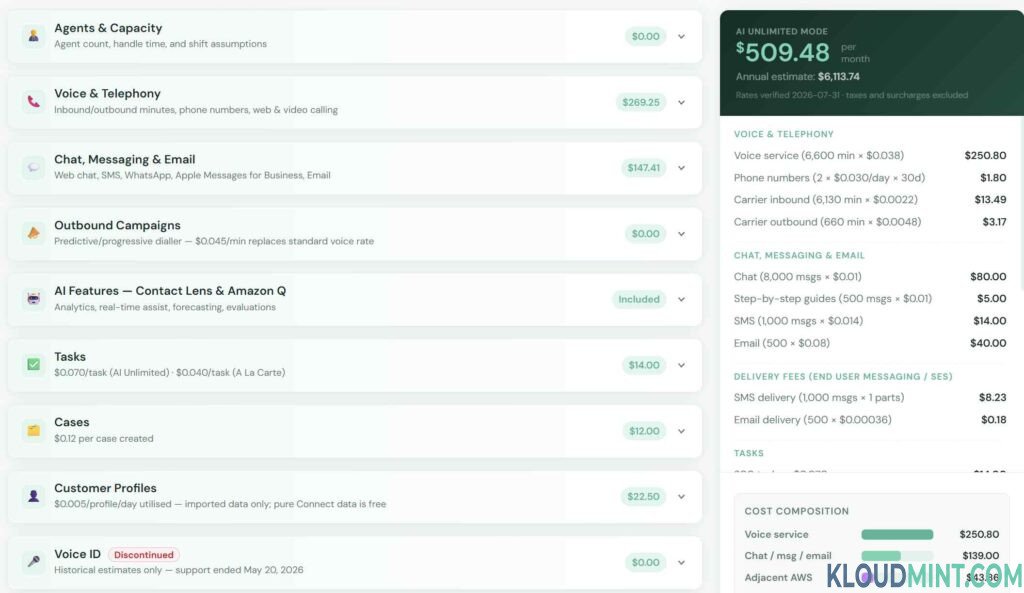
Calculate your estimated Amazon Connect monthly cost before deploying.
To get a useful estimate, plug in your expected monthly minutes and messages per channel, your phone number count and country, and which optional features (analytics, agent assistance, forecasting) you intend to enable. The output is a modeled estimate, not a guaranteed AWS invoice — your actual bill can differ based on call patterns, taxes, telecom surcharges, and any AWS services outside the calculator’s scope (for example, custom Lambda logic beyond a baseline estimate, or Bedrock-based AI agents).
Amazon Connect Pricing in India
Amazon Connect service pricing itself (the per-minute/per-message channel rates above) is the same globally — AWS doesn’t publish a separate discounted “India rate” for the core service. What differs for India-based deployments is telephony and number availability.
A few things worth knowing before estimating India costs:
- Region: Amazon Connect is not offered as a hosted region within India itself; Indian businesses typically run their Connect instance from a nearby AWS region (commonly Asia Pacific — Singapore or Mumbai, depending on current regional availability) and obtain Indian phone numbers through AWS’s telephony coverage.
- Numbers: India appears in AWS’s Shared Trunking coverage list, meaning DID and toll-free numbers for India are supported through a partner-carrier arrangement. In Shared Trunking, the carrier bills for the number directly, while Amazon Connect bills the usage minutes.
- Inbound/national outbound rate: Shared Trunking rates for India are $0.0022 per minute for inbound and national outbound calls, per AWS’s published Shared Trunking pricing.
- International outbound from India: billed at AWS’s standard international outbound telephony rates by destination, not the Shared Trunking rate.
- Porting and custom caller ID: based on AWS’s own network coverage documentation, some capabilities (national/international outbound porting, custom caller ID) may not be supported for India-originated numbers in every configuration — confirm current availability with AWS or a certified partner before committing to a specific number type.
- Taxes and surcharges: Indian GST and any applicable telecom levies apply on top of AWS’s usage charges, separate from the AWS bill itself.
Example INR conversion only; AWS billing may be in USD or another billing currency depending on the account/billing setup. At a rough illustrative rate of ₹88/USD, the small-contact-center example above (≈$263/month) would be roughly ₹23,100/month before Indian taxes — a conversion for context only, not an AWS-published figure.
Because India telephony runs through a shared-trunk/carrier partner model, the most reliable way to estimate India-specific costs is to model your actual expected call volumes and destinations (domestic vs. international) rather than relying on a single blended “India price.”
Amazon Connect Phone Number Pricing
Phone numbers are billed separately from call-minute usage, on a per-day basis, plus applicable per-minute telephony charges:
| Number type | Illustrative US rate | Notes |
|---|---|---|
| Direct Inward Dial (DID) | $0.03/day | Standard local number |
| Toll-free (TFN) | $0.06/day | US toll-free |
| Universal International Freephone (UIFN) | From ~$1.20/day where available | Requires minimum five countries enabled |
| Shared Trunking countries (e.g., India, Brazil, Indonesia, UAE) | Number billed by the telco partner; usage billed by AWS at $0.0022/min inbound & national outbound | Number and usage billed by two different parties |
On top of the daily number fee, every call is billed the applicable inbound or outbound telephony rate (for example, $0.0022/minute inbound and $0.0048/minute outbound to US destinations), separately from the $0.018 or $0.038 Amazon Connect voice service charge. More than 100 countries are supported for DID, TFN, and UIFN numbers, with country-specific day rates and per-minute telephony rates published in AWS’s Global Telephony pricing tables.
Amazon Connect International Calling Pricing
International outbound calling is one of the fastest ways an Amazon Connect bill can grow unexpectedly, because outbound rates are destination-specific and can vary by an order of magnitude between countries.
Key points:
- Outbound rates cover “blended national and international calling to landline, mobile, and higher-cost destinations,” per AWS — meaning a call to a mobile number in one country can cost noticeably more than a landline call in another.
- High-cost destinations are subject to AWS’s acceptable use policy, and some destinations may require additional approval.
- Inbound and outbound calls are billed per-second with a 60-second minimum per AWS’s telephony billing rules.
- AWS’s Global Telephony section publishes the full country-by-country outbound rate table — always check it directly for current destination-level pricing rather than relying on a handful of cited examples, since rates for individual countries change periodically.
If your business routes meaningful outbound volume to specific countries, model those destinations individually in a calculator rather than applying a single blended average — a contact center with heavy outbound calling to Europe will have a very different bill than one calling mostly domestic US numbers, even at identical minute volumes.
Amazon Connect AI Pricing
AI is where Amazon Connect’s two pricing models diverge the most. As of the April 2026 rebrand, AWS’s stated intent is “all-you-can-eat AI pricing that remains tied only to your underlying channel usage rather than AI consumption” under Connect Customer (Unlimited AI) pricing.
| Capability | Included in Connect Customer (Unlimited AI)? | Customer Basic price |
|---|---|---|
| Conversational analytics & post-contact summaries | Yes, bundled | $0.015/min (voice, first 5M min/mo), $0.0015/message |
| Real-time agent assistance | Yes, bundled | $0.0080/min, $0.0015/message, $0.020/inbound email |
| End-customer self-service (AI agents, includes Lex) | Yes, bundled | $0.0080/min, $0.0015/message, plus separate Lex charges |
| Performance evaluation of agents | Yes, bundled | $12/agent/month |
| Forecasting & agent scheduling | Not included in the channel rate — always $27/agent/month | $27/agent/month |
| Screen recording | Yes, bundled | $0.0060/recorded minute |
| Voice ID (fraud/identity verification) | Being discontinued — end of support effective May 20, 2026, no new customer access | Same |
| AI agents using Bedrock AgentCore Gateway or Knowledge Bases | Not included — billed separately under Bedrock pricing | Same |
A few things worth flagging for accuracy: forecasting and agent scheduling is billed per agent per month regardless of which channel pricing model you’re on, generative AI-powered post-contact summaries carry no separate charge beyond the conversational analytics fee, and custom AI agents that call out to Amazon Bedrock (AgentCore Gateway or Knowledge Bases) incur Bedrock’s own charges on top of Connect pricing.
The practical question isn’t “does Amazon Connect include AI” — it’s “how many AI features will you actually turn on, and at what volume.” If the answer is “several, across most of your traffic,” Connect Customer pricing usually simplifies the bill. If it’s “one or two, sparingly,” Customer Basic’s lower base rate is often cheaper.
What Are the Hidden or Additional Amazon Connect Costs?
Amazon Connect charges cover the contact-center service itself. Several categories of cost sit outside that and show up as separate line items on your AWS bill:
- Telephony carrier charges — separate from the Connect voice service fee, billed per minute by destination
- Phone numbers — daily fees, plus (for Shared Trunking countries) a separate carrier-partner bill
- AWS Lambda — for custom contact-flow logic, CRM integrations, or automation
- Amazon S3 — for storing call recordings, transcripts, and screen recordings
- Amazon Lex — for bot/self-service conversations beyond what’s bundled into Connect Customer pricing
- Amazon Polly — for generative or custom text-to-speech voices beyond the included set
- Amazon Bedrock — for custom AI agents or knowledge bases
- Amazon End User Messaging — SMS, WhatsApp, and Apple Messages for Business delivery fees, on top of Connect’s per-message channel charge
- Amazon SES — email delivery fees, on top of Connect’s per-email channel charge
- Data transfer and storage across the services above
- Taxes and telecom surcharges, which vary by country and are billed on top of usage
The distinction that matters most: Amazon Connect service charges are what AWS publishes on the Connect pricing page. Everything else above is a separate AWS (or carrier) service that a typical deployment relies on, billed under that service’s own pricing page.
Amazon Connect Pricing Example (Step by Step)
Business assumptions: 20 agents, Customer Basic pricing, US DID number, US-WEST-2.
- 40,000 inbound voice minutes
- 8,000 outbound voice minutes (to US destinations)
- 25,000 chat messages
- 2 US DID numbers
- Real-time agent assistance enabled on voice
Calculation:
- Voice service charge: (40,000 + 8,000) × $0.018 = $864
- Inbound telephony: 40,000 × $0.0022 = $88
- Outbound telephony (US): 8,000 × $0.0048 = $38.40
- DID number fees: 2 numbers × $0.03/day × 30 days = $1.80
- Chat channel usage: 25,000 × $0.004 = $100
- Agent assistance (voice): 48,000 × $0.008 = $384
Estimated monthly total: $864 + $88 + $38.40 + $1.80 + $100 + $384 = $1,476.20, plus applicable taxes, fees, and any Lambda/S3/Lex usage tied to the deployment.
This is reproducible: change any input and the total moves proportionally.
Amazon Connect Cost-Saving Tips
- Model both Connect Customer and Customer Basic pricing against your actual feature usage before choosing — don’t assume one is always cheaper
- Audit international outbound destinations regularly; a handful of high-cost destinations can dominate a bill
- Release unused or duplicate phone numbers — daily fees add up across dozens of idle DIDs
- Review your channel mix; shifting simple, low-value inbound volume to chat or self-service AI can lower per-contact cost
- Track feature usage (agent assistance, screen recording, forecasting) against actual value delivered, not just because it’s available
- Review call routing to avoid unnecessary transfers, which add outbound-minute charges
- Control recording retention in S3 — old recordings kept indefinitely add ongoing storage cost
- Use AWS Cost Explorer and budgets/alerts to monitor Connect-related spend across all the services it touches, not just the Connect line item
- Model your architecture in a calculator before deployment rather than after the first invoice arrives
Is Amazon Connect Expensive?
There’s no single yes or no answer. Amazon Connect’s pay-as-you-go model can be very cost-effective for a business with modest, predictable volumes, low international outbound traffic, and light feature usage — often cheaper than a seat-licensed CCaaS platform. The same model can produce a large bill for a high-volume operation with long call durations, heavy international calling, and every AI feature turned on across every contact.
A practical framework for deciding whether the pricing fits your deployment:
- Usage volume and call duration — higher volume and longer calls scale the per-minute charges directly
- Channel mix — voice is priced meaningfully higher than chat or messaging per interaction
- Geography — international outbound and non-Shared-Trunking countries can carry higher telephony rates
- AI/feature intensity — how many optional capabilities you’ll actually use, and on what share of your traffic
- Number of phone numbers — daily fees scale with how many DIDs/TFNs you maintain
- Integrations and infrastructure — Lambda, S3, Bedrock, and messaging/email delivery costs sit alongside the core Connect charges
Rather than asking whether Amazon Connect is “expensive” in the abstract, model your specific usage pattern against both pricing plans and compare the total to what a seat-licensed alternative would cost for the same volume.
Frequently Asked Questions
Is Amazon Connect free?
Not entirely, but AWS offers a Free Tier during the first 12 months covering limited usage — for example, 90 minutes of voice service and 30 minutes of outbound telephony per month, plus limited free tiers for Customer Profiles and conversational analytics trials. Beyond those limits, standard pay-as-you-go rates apply.
Does Amazon Connect have a monthly subscription fee?
No. There’s no flat monthly subscription or per-seat license fee. You pay based on usage — minutes, messages, emails, phone numbers, and any optional features enabled.
How much does Amazon Connect cost per minute?
The core voice service charge is $0.018 per minute under Customer Basic pricing, or $0.038 per minute under Connect Customer (Unlimited AI) pricing. Separate telephony (carrier) charges apply on top, by destination.
How much does Amazon Connect cost per month?
There’s no fixed monthly price — it depends on your usage. Small deployments can run a few hundred dollars a month; larger, feature-heavy deployments can run into the thousands or tens of thousands. Use the calculations above, or a calculator, to model your own volumes.
How much does Amazon Connect cost in India?
Core service rates are the same globally. India-specific costs mainly come from telephony: India is supported through AWS’s Shared Trunking model at $0.0022 per minute for inbound and national outbound, with international outbound billed at standard destination rates, plus applicable Indian taxes.
How much do Amazon Connect phone numbers cost?
US DID numbers are $0.03/day and toll-free numbers $0.06/day, illustratively; rates vary by country. Numbers in Shared Trunking countries are billed by the telco partner directly, with AWS billing only the usage minutes.
Does Amazon Connect charge for inbound calls?
Yes — inbound calls incur both the Amazon Connect voice service charge and a separate per-minute inbound telephony charge.
How much does international calling cost?
It varies significantly by destination; AWS publishes a full country-by-country outbound rate table in its Global Telephony pricing section, and high-cost destinations are subject to an acceptable use policy.
What is Amazon Connect Basic?
“Customer Basic” (formerly “Individual Features”) is the pricing plan with a lower base channel rate where AI, analytics, and other capabilities are billed separately, à la carte, rather than bundled into the rate.
Does Amazon Connect include AI?
Under Connect Customer (Unlimited AI) pricing, major AI and analytics capabilities are bundled into the channel rate. Under Customer Basic, AI features are billed separately per use.
Is Amazon Connect AI included in the price?
Only under the Connect Customer (Unlimited AI) plan. Under Customer Basic, most AI capabilities carry their own per-minute or per-message charge, and some AI-only capabilities (like Amazon Nova Sonic or AI-powered case summarization) aren’t offered on Customer Basic at all.
Does Amazon Connect have a pricing calculator?
Yes — AWS’s own pricing appendix includes worked examples, and third-party tools such as the KloudMint Amazon Connect Price Calculator let you model your own usage across channels, telephony, and features.
What additional AWS services can increase Amazon Connect costs?
Lambda, S3, Lex, Polly, Bedrock, Amazon End User Messaging (SMS/WhatsApp delivery), and Amazon SES (email delivery) are the most common services that add cost alongside the core Amazon Connect charges.
Conclusion
Amazon Connect pricing is usage-driven, not subscription-based — the headline per-minute or per-message rate is only one part of the total bill. Which pricing plan fits best, Connect Customer (Unlimited AI) or Customer Basic, depends on how much AI and analytics functionality you’ll actually use across your volume. Telephony and phone numbers are billed separately from the core service charge, international calling can shift the economics significantly, and AI features need to be understood on their own terms rather than assumed to be free. Modeling your expected monthly usage — rather than anchoring on a single unit price — is the only reliable way to know what Amazon Connect will actually cost your business.
Use the Amazon Connect Pricing Calculator to estimate your monthly deployment cost based on your actual usage.
Reference – AWS Amazon Connect Customer Pricing